Introductory Context
"A comprehensive and in-depth guide to Flexi Cap Mutual Funds covering SEBI allocation norms, portfolio flexibility, risk-return behavior, market cycle adaptability, manager strategy and long-term investor suitability."
Flexi Cap Mutual Funds – Freedom with Responsibility
Flexi Cap Mutual Funds are among the most strategically flexible categories within the SEBI-regulated equity mutual fund framework. Unlike Large Cap, Mid Cap, Small Cap or Multi Cap funds — where allocation mandates are tightly defined — Flexi Cap Funds provide fund managers the freedom to allocate capital dynamically across market capitalizations.
Under SEBI’s categorization guidelines:
A Flexi Cap Mutual Fund must invest at least 65% of total assets in equity and equity-related instruments.
There are no restrictions on allocation between large-cap, mid-cap and small-cap stocks.
This single difference — absence of market-cap allocation constraints — makes Flexi Cap Funds structurally distinct.
They are not forced to maintain fixed exposure to any segment. The fund manager can move capital where opportunity appears strongest.
And that freedom introduces both opportunity and risk.
SEBI Flexi Cap Rule
Flexi Cap Mutual Funds must maintain at least 65% equity allocation but have no restriction on distribution across large, mid or small-cap stocks.
Why Flexi Cap Category Exists
SEBI introduced the Flexi Cap category in 2020 to differentiate it clearly from Multi Cap Funds.
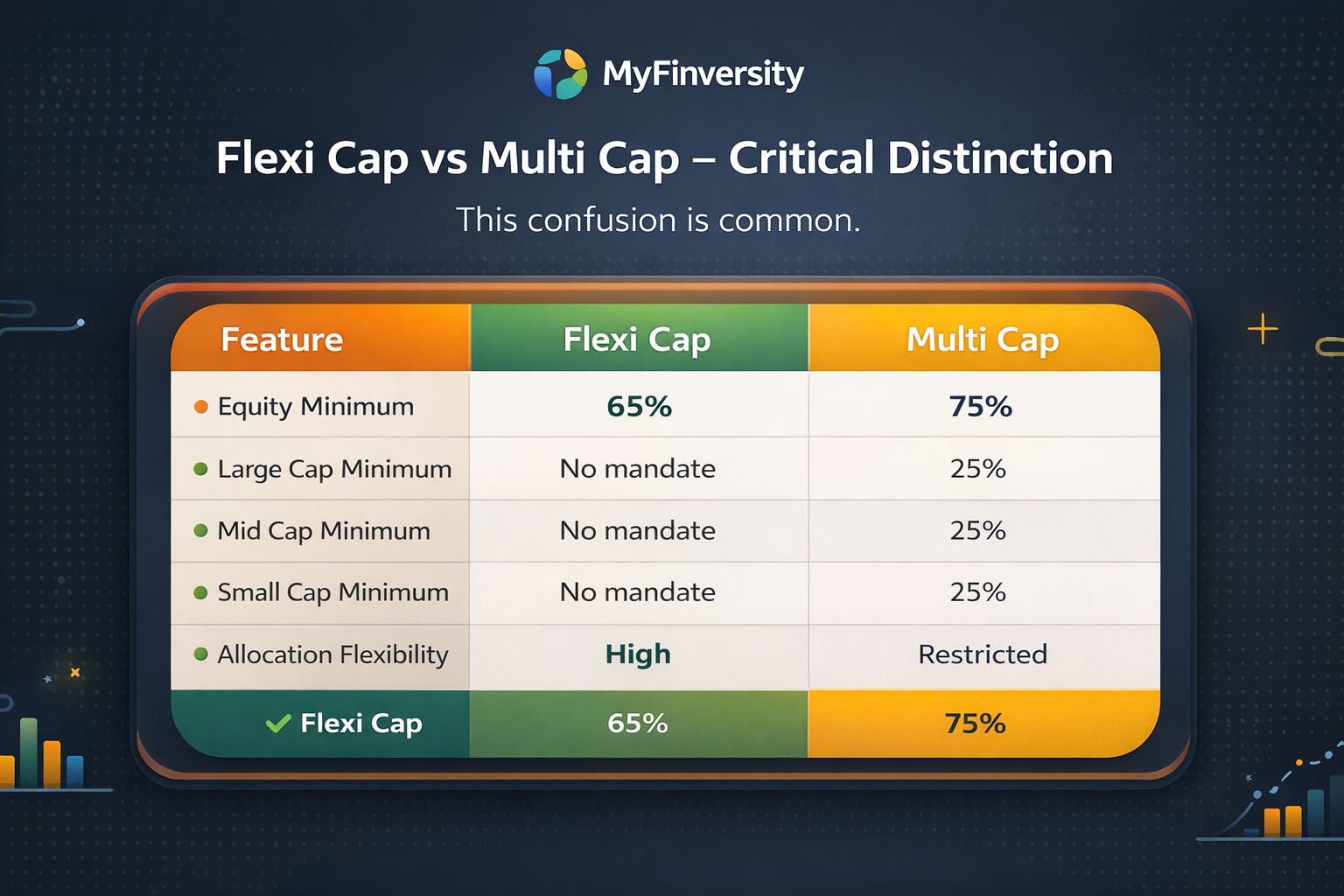
Earlier, many “Multi Cap” funds were heavily skewed toward large caps. When SEBI mandated 25% allocation each to large, mid and small caps in Multi Cap Funds, the industry needed a category that retained managerial flexibility.
Flexi Cap became that solution.
The philosophy behind Flexi Cap Funds is simple:
Markets are dynamic.
Leadership rotates.
Rigid allocation rules can limit performance.
Flexi Cap Funds allow fund managers to:
Increase large-cap allocation during uncertain environments
Shift toward mid-caps during growth acceleration
Take selective small-cap exposure when risk appetite improves
This is active capital allocation within equity.
Allocation Flexibility – What It Really Means
Unlike Multi Cap Funds (25%-25%-25% rule) or Large & Mid Cap Funds (35%-35% rule), Flexi Cap Funds can structure portfolios like:
80% Large Cap + 15% Mid Cap + 5% Small Cap
40% Large Cap + 40% Mid Cap + 20% Small Cap
30% Large Cap + 50% Mid Cap + 20% Small Cap
The flexibility allows fund managers to respond to:
Economic cycles
Liquidity conditions
Valuation dispersion
Earnings momentum
Global macro shifts
This dynamic nature makes Flexi Cap Funds more manager-dependent than rule-bound categories.
Risk Characteristics
Flexi Cap Funds do not have a fixed risk profile. Their risk level depends on current portfolio allocation.
Key risk dimensions include:
1. Allocation Risk
Performance is heavily influenced by how the manager allocates between large, mid and small caps at different times.
2. Manager Skill Risk
The absence of allocation discipline increases reliance on fund manager judgment.
3. Volatility Variability
Volatility may change depending on portfolio structure. A Flexi Cap Fund with 70% mid-cap exposure behaves differently from one with 70% large-cap exposure.
4. Style Drift
Although flexibility is allowed, excessive tactical shifts may impact consistency.
This category rewards disciplined managers but punishes misallocation.
Manager Dependency Risk
Flexi Cap Mutual Funds are highly dependent on fund manager skill due to unrestricted allocation flexibility.
Risk-Return Behaviour Across Market Cycles
The real power of Flexi Cap Funds becomes visible across economic transitions.
During Economic Uncertainty
Managers may tilt toward large caps for stability.
During Domestic Growth Expansion
Mid-cap exposure may increase to capture earnings acceleration.
During Liquidity-Driven Rallies
Selective small-cap exposure may enhance returns.
During Market Corrections
Managers may reduce high-beta segments to preserve capital.
This adaptability allows Flexi Cap Funds to potentially navigate cycles more smoothly than rigid categories — provided allocation decisions are timely and disciplined.
Historically, well-managed Flexi Cap Funds have demonstrated:
Strong long-term compounding
Lower drawdowns compared to pure small-cap funds
Higher return potential compared to pure large-cap funds
But dispersion between best and worst performers in this category can be wide.
Adaptability Advantage
Flexi Cap Funds benefit from the ability to shift allocations as market leadership changes.
Real Market Behaviour Insights
In Indian markets:
During global crises, managers have historically increased large-cap weight to reduce volatility.
During reform-driven growth cycles, mid-cap allocation often rises.
During speculative phases, selective small-cap exposure enhances returns.
Flexi Cap Funds are often considered “all-weather equity funds” — not because they avoid volatility, but because they adapt to it.
However, adaptability must not be confused with market timing perfection.
Portfolio Construction Approach
Fund managers in Flexi Cap Funds typically focus on:
Relative valuation opportunities
Sector rotation themes
Macro-economic outlook
Earnings momentum
Risk management overlay
Because they are not bound by allocation mandates, portfolio strategy is more discretionary and thesis-driven.
Expense ratios should be evaluated relative to demonstrated alpha and consistency.
Evaluate Allocation Track Record
Before investing in a Flexi Cap Fund, examine historical allocation patterns across market cycles.
Flexi Cap vs Multi Cap – Critical Distinction
This confusion is common.
Flexi Cap Funds offer flexibility.
Multi Cap Funds enforce structural diversification.
Choosing between them depends on whether an investor prefers:
Manager freedom
or
Regulatory discipline.
Suitable Investor Profile
Flexi Cap Mutual Funds may be suitable for:
Investors seeking one diversified equity fund
Investors trusting active management
Long-term investors (5–10 years)
Individuals comfortable with allocation shifts
They may not be suitable for:
Investors who prefer predictable allocation structure
Extremely conservative investors
Short-term investors
Flexi Cap Funds are often positioned as “core diversified equity funds” in modern portfolios.
Blind Trust Risk
Investing in a Flexi Cap Fund without evaluating manager consistency can increase allocation risk.
Role in Asset Allocation Strategy
Flexi Cap Funds can act as:
Standalone diversified equity exposure
Core holding in a long-term portfolio
Alternative to holding separate large and mid-cap funds
For investors seeking simplicity with professional allocation management, Flexi Cap Funds offer strategic convenience.
Taxation
Flexi Cap Mutual Funds are taxed under equity taxation rules:
Short-Term Capital Gains (< 12 months): 15%
Long-Term Capital Gains (> 12 months): 10% above exemption limit
Tax structure aligns with other diversified equity categories.
Analytical Summary
Flexi Cap Mutual Funds represent adaptive equity investing. By removing rigid market-cap allocation constraints, they empower fund managers to respond dynamically to evolving market conditions.
This flexibility can enhance performance consistency — but only when supported by disciplined allocation strategy and strong research capability.
For long-term investors seeking strategic diversification without structural rigidity, Flexi Cap Funds offer a compelling and human-centered investing approach.