Introductory Context
"A detailed explanation of how mutual funds are classified based on management style, covering active vs passive investing, index funds, ETFs, cost structures, tracking error and investor suitability."
Classification of Mutual Funds by Management Style
Not all mutual funds are managed in the same way. Two equity funds may invest in the same market, yet their approach to stock selection, risk control, and performance measurement can differ fundamentally.
This difference arises from management style.
While structural classification determines liquidity and asset classification determines risk exposure, management style determines how returns are pursued. It defines whether a fund attempts to outperform the market or simply replicate it.
In India, mutual funds are broadly classified into:
Actively Managed Funds
Passively Managed Funds
Understanding this distinction is essential because it affects cost, performance expectation, volatility behavior, and long-term strategy.
I. Actively Managed Funds
An actively managed fund is one where a professional fund manager makes discretionary decisions about:
Which securities to buy
When to buy or sell
How much weight to allocate
Which sectors to overweight or underweight
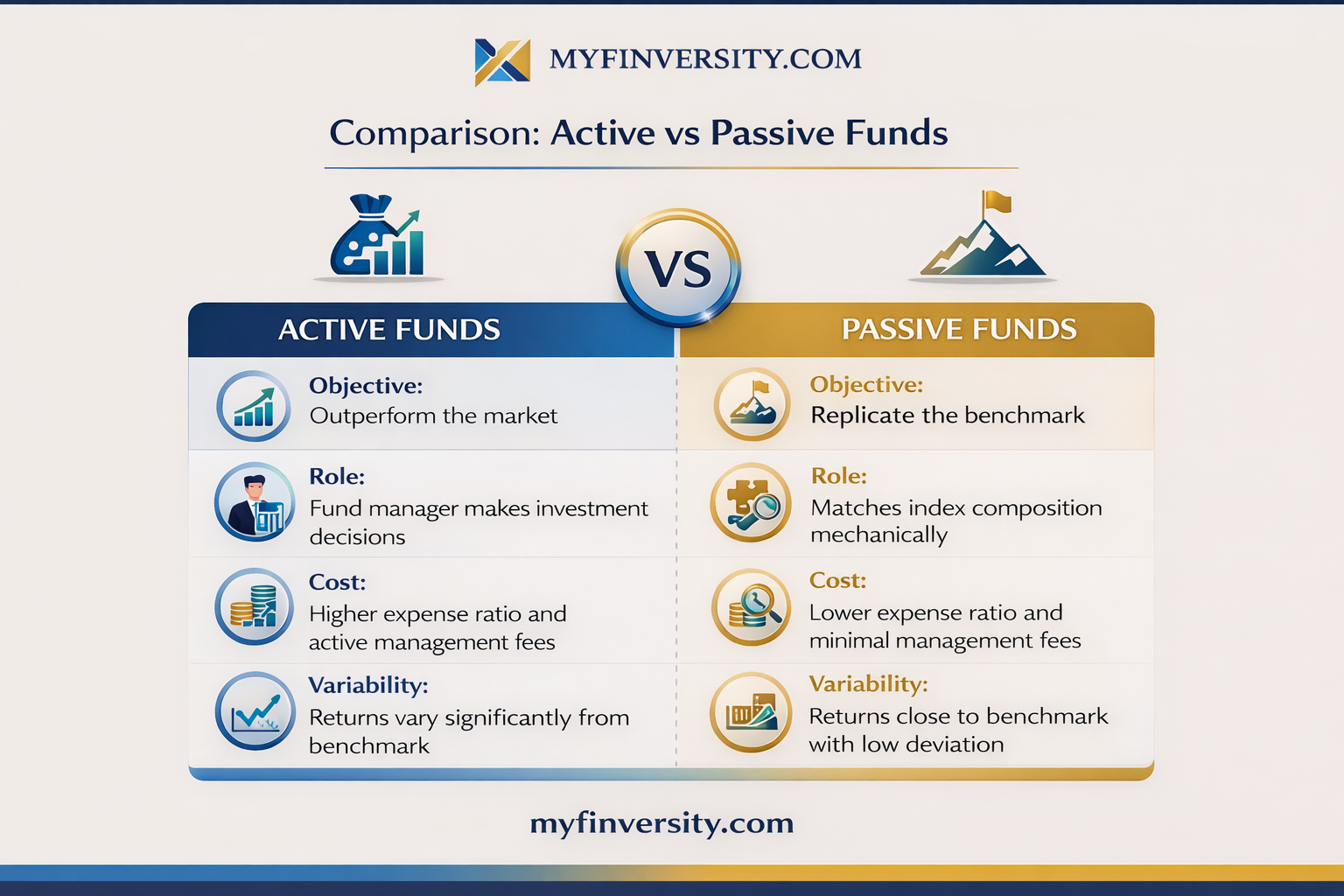
The objective of active management is to generate alpha — that is, returns higher than the benchmark index.
For example, a large-cap equity fund may use Nifty 100 as its benchmark. An active fund manager will attempt to outperform this index through stock selection and timing decisions.
How Active Management Works
Active management relies on:
Fundamental research
Economic forecasting
Sector analysis
Company earnings projections
Valuation assessment
Risk management overlays
Portfolio composition may deviate significantly from the benchmark.
This deviation is often measured through metrics like active share and tracking difference.
Alpha Objective
Actively managed funds aim to outperform their benchmark index through research-driven security selection.
Cost Structure of Active Funds
Because active management requires research teams, analyst coverage, and portfolio turnover, expense ratios are generally higher compared to passive funds.
Costs include:
Fund management fees
Research expenses
Transaction costs
Portfolio churn impact
Higher cost does not guarantee higher returns. It only reflects a more intensive management process.
Cost vs Performance Reality
Higher expense ratios in active funds do not automatically translate into superior returns.
Strengths of Active Management
Active funds may offer:
Downside risk management in volatile markets
Tactical sector allocation
Ability to avoid weak stocks
Flexibility to hold cash (in certain strategies)
In inefficient markets or specific segments like small caps, active management may potentially add value.
Limitations of Active Management
However, active funds also face challenges:
Consistency of outperformance is difficult
Performance depends on fund manager skill
Style drift risk
Higher cost drag
Long-term alpha generation requires sustained skill — which is statistically challenging across large universes.
II. Passively Managed Funds
Passively managed funds do not attempt to outperform a benchmark. Instead, they aim to replicate the performance of a specified index.
Examples include:
Nifty 50 Index Funds
Sensex ETFs
Nifty Next 50 Index Funds
The fund manager does not make discretionary stock selection decisions beyond maintaining alignment with the benchmark.
How Passive Management Works
In passive funds:
Portfolio composition mirrors the benchmark index.
Weightage of each stock matches index allocation.
Rebalancing occurs when index constituents change.
Performance objective is not alpha generation but tracking accuracy.
The difference between fund return and benchmark return is called tracking error.
Tracking Error Defined
Tracking error measures how closely a passive fund replicates its benchmark performance.
Cost Advantage of Passive Funds
Because passive funds do not require extensive research or frequent trading, their expense ratios are typically lower.
Lower costs improve long-term compounding efficiency.
This cost advantage becomes significant over extended investment horizons.
Long-Term Cost Efficiency
Even small differences in expense ratio can significantly impact long-term returns due to compounding.
Index Funds vs ETFs
Within passive management, two common vehicles exist:
Index Funds
Purchased and redeemed directly with AMC
NAV-based pricing
Suitable for SIPs
No demat account required
Exchange Traded Funds (ETFs)
Listed and traded on stock exchanges
Bought and sold like stocks
Require demat and trading account
Price may vary slightly from NAV due to market demand
While both track indices, liquidity mechanics differ.
ETF Liquidity Risk
Low trading volume in ETFs may lead to price deviations from NAV in certain market conditions.
When Does Each Style Make Sense?
Active management may be suitable when:
Market inefficiencies exist
Fund manager track record is strong
Investor seeks tactical flexibility
Passive management may be suitable when:
Long-term compounding is priority
Cost efficiency matters
Broad market exposure is desired
Investor prefers simplicity
Both styles can coexist in a diversified portfolio.
Hybrid Approach in Modern Portfolios
Many investors combine active and passive funds. For example:
Passive large-cap exposure
Active mid-cap allocation
Passive international exposure
Management style is not a binary choice — it is a strategic allocation decision.
Final Perspective
Classification by management style clarifies the philosophy behind a mutual fund. Active funds attempt to outperform markets through skill and research. Passive funds accept market returns and optimize cost efficiency.
Neither approach is universally superior. Their effectiveness depends on:
Market conditions
Cost structures
Time horizon
Investor discipline
Understanding management style prevents unrealistic expectations and aligns strategy with financial goals.
In the next section, we move to classification by investment universe — where we examine how schemes are categorized based on asset allocation and investment mandate.