Detailed Introductory Concept
Compounding is one of the most powerful and misunderstood forces in finance. While most people understand that money grows when invested, very few grasp how time and rate of return interact to produce exponential outcomes. The Rule of 72, 114, and 144 are mental calculation tools designed to simplify this complexity. They allow investors to quickly estimate how long it will take for their money to double, triple, or quadruple at a given annual rate of return.
These rules are not magic formulas. They are approximations derived from logarithmic mathematics that make compound growth intuitive without requiring a calculator. Used correctly, they build rate-of-return awareness, improve long-term decision making, and sharpen financial judgment. Used carelessly, they can oversimplify assumptions about risk and consistency.
This topic explores the mathematical foundation, practical application, limitations, and behavioral significance of these time multipliers in investing and financial planning.
Most people focus on how much return they can earn. Very few ask a more important question:
“How long will it take?”
If someone says an investment gives 10% per year, it sounds good. But what does that actually mean? When will your ₹1 lakh become ₹2 lakh? When will it become ₹4 lakh? Is that 5 years? 10 years? 20 years?
Without understanding time, return percentages are just numbers.
The Rule of 72, 114, and 144 were created to answer this exact problem. They are not investment tricks. They are not strategies. They are simple time-estimation tools that help beginners understand how compounding really behaves.
Once you understand these rules, you will never look at percentage returns the same way again.
1. Why Most Beginners Misunderstand Compounding
When people hear the word “compounding,” they imagine steady growth. They assume money grows gradually and evenly. The truth is very different.
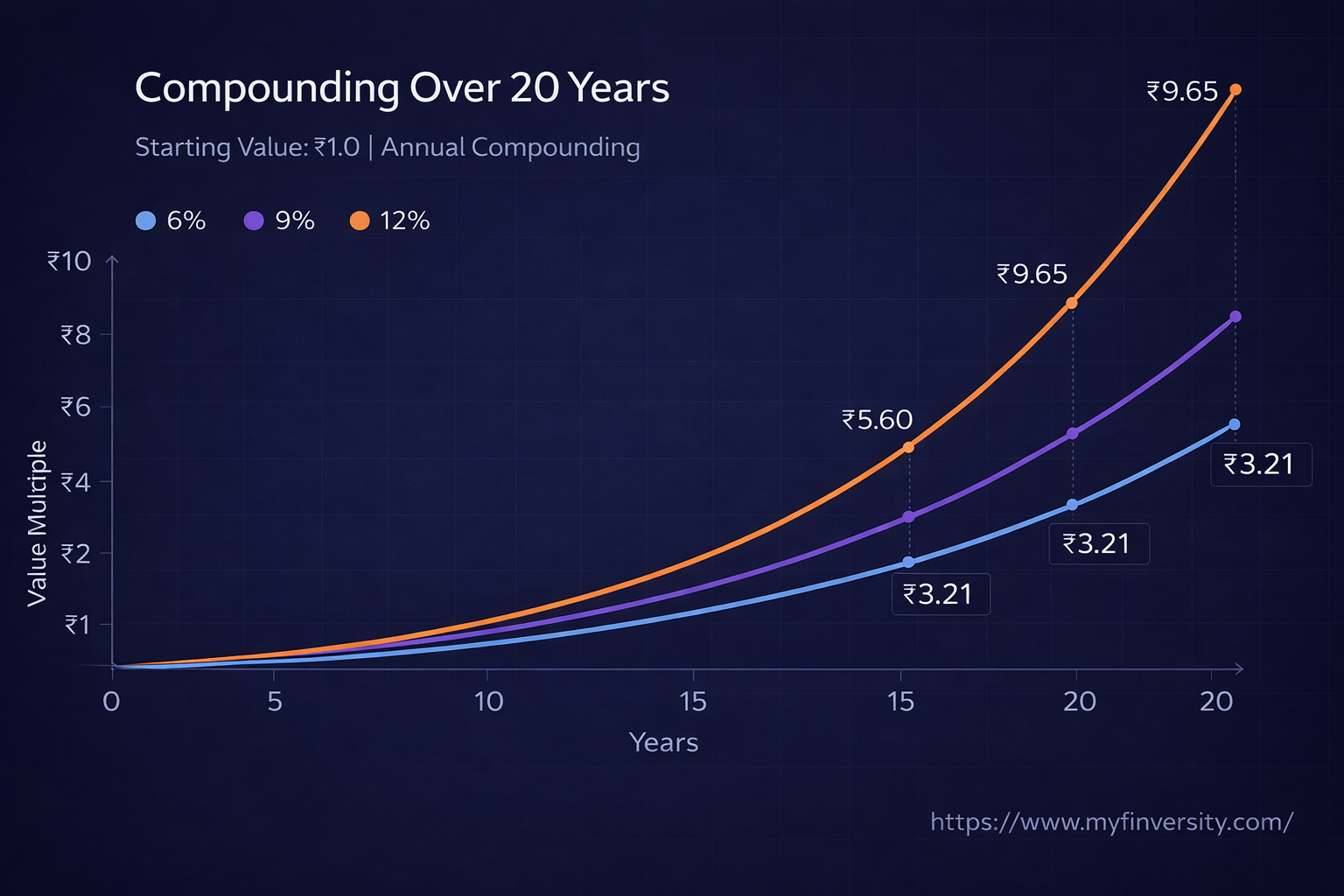
Compounding is slow in the beginning and powerful later. In the early years, growth looks unimpressive. Many people lose patience during this phase. They withdraw money, change investments, or chase something faster. What they fail to see is that compounding behaves like a snowball rolling down a hill. It gathers momentum slowly at first, then accelerates dramatically.
The biggest mistake beginners make is underestimating time. They either expect quick doubling, or they do not realize how powerful consistent growth becomes over decades.
This is where the Rule of 72 becomes important.
2. The Rule of 72 – When Will My Money Double?
The Rule of 72 gives a quick answer to a powerful question:
“If my money grows at a certain annual rate, how many years will it take to double?”
The formula is simple:
Years to Double ≈ 72 ÷ Annual Return (%)
Let us understand this slowly.
If you earn 6% per year:
72 ÷ 6 = 12 years
If you earn 9% per year:
72 ÷ 9 = 8 years
If you earn 12% per year:
72 ÷ 12 = 6 years
Now pause and observe something important.
A small increase from 6% to 12% does not just increase return slightly. It cuts the waiting time in half. That is the power of compounding. Higher returns compress time dramatically.
This is why investors who understand compounding focus on both rate and duration.
Think About This
If inflation averages 6%, your purchasing power halves roughly every 12 years. The same rule applies in reverse. Compounding works positively for investments and negatively against savings that earn too little.
3. Why the Number 72?
Many beginners wonder where 72 comes from. It is not random.
Compounding follows a mathematical pattern:
Future Value = Principal × (1 + r)^n
Solving this exactly requires logarithms, which most people do not use daily. To make life easier, mathematicians created an approximation. The number 72 works well for common return ranges between 6% and 12%, and it is easy to divide mentally.
The purpose of the rule is not perfection. It is clarity. It helps you develop time awareness without a calculator.
4. The Rule of 114 – When Will My Money Triple?
Once doubling is understood, the next question is natural:
“How long will it take to triple?”
The Rule of 114 provides that estimate.
Years to Triple ≈ 114 ÷ Annual Return (%)
At 10% return:
114 ÷ 10 = 11.4 years
At 12% return:
114 ÷ 12 ≈ 9.5 years
Tripling takes longer than doubling, and most beginners underestimate that difference. Compounding accelerates, but it still requires patience.
The key lesson here is that serious wealth creation requires staying invested long enough for multiple cycles of growth.
5. The Rule of 144 – When Will My Money Quadruple?
Quadrupling shows the deeper power of compounding.
Years to Quadruple ≈ 144 ÷ Annual Return (%)
At 8% return:
144 ÷ 8 = 18 years
At 12% return:
144 ÷ 12 = 12 years
Notice how long it takes. True wealth building is not a 2–3 year activity. It is a decade-based process.
These rules quietly teach an important truth: time is the real multiplier.
6. Why These Rules Matter in Real Life
For beginners, these rules do three important things.
First, they create realistic expectations. When someone expects money to double in 3 years at normal market returns, disappointment is inevitable. The Rule of 72 removes illusion.
Second, they highlight the cost of delay. If you postpone investing by 5 years, you are not just losing 5 years—you are losing an entire compounding cycle.
Third, they reveal the danger of high-interest debt. If a credit card charges 18%, your debt can double in roughly 4 years (72 ÷ 18 = 4). Compounding works against you as powerfully as it works for you.
Understanding these time multipliers builds financial maturity.
Patience Is Not Emotional. It Is Mathematical.
Compounding rewards those who stay invested. Most people quit during the slow phase and never reach the acceleration phase.
7. Limitations You Must Know
These rules are estimates. They assume:
A consistent annual return
No interruption
No taxes or fees
Real markets fluctuate. Actual doubling time may vary. But even with variation, the intuition remains powerful.
The goal is not precision to the decimal. The goal is understanding how rate and time interact.
Frequently Asked Questions
Conclusion
The Rule of 72, 114, and 144 are simple tools, but their impact on financial thinking is profound. They convert abstract percentages into meaningful timelines. They teach that wealth creation is not about speed, but about sustained growth over long periods.
For a beginner, understanding these rules is often the first step toward respecting time in finance. Once time is respected, discipline follows. And once discipline follows, compounding can begin to work in your favor.
Disclaimer: While due care has been taken to ensure the accuracy, clarity, and relevance of the information, the content is intended solely for educational purposes. Financial terms and concepts are interpretative tools; readers are strongly advised to verify information from multiple sources and apply their own judgment. This content does not constitute financial, investment, or advisory recommendations of any kind.