Introductory Context
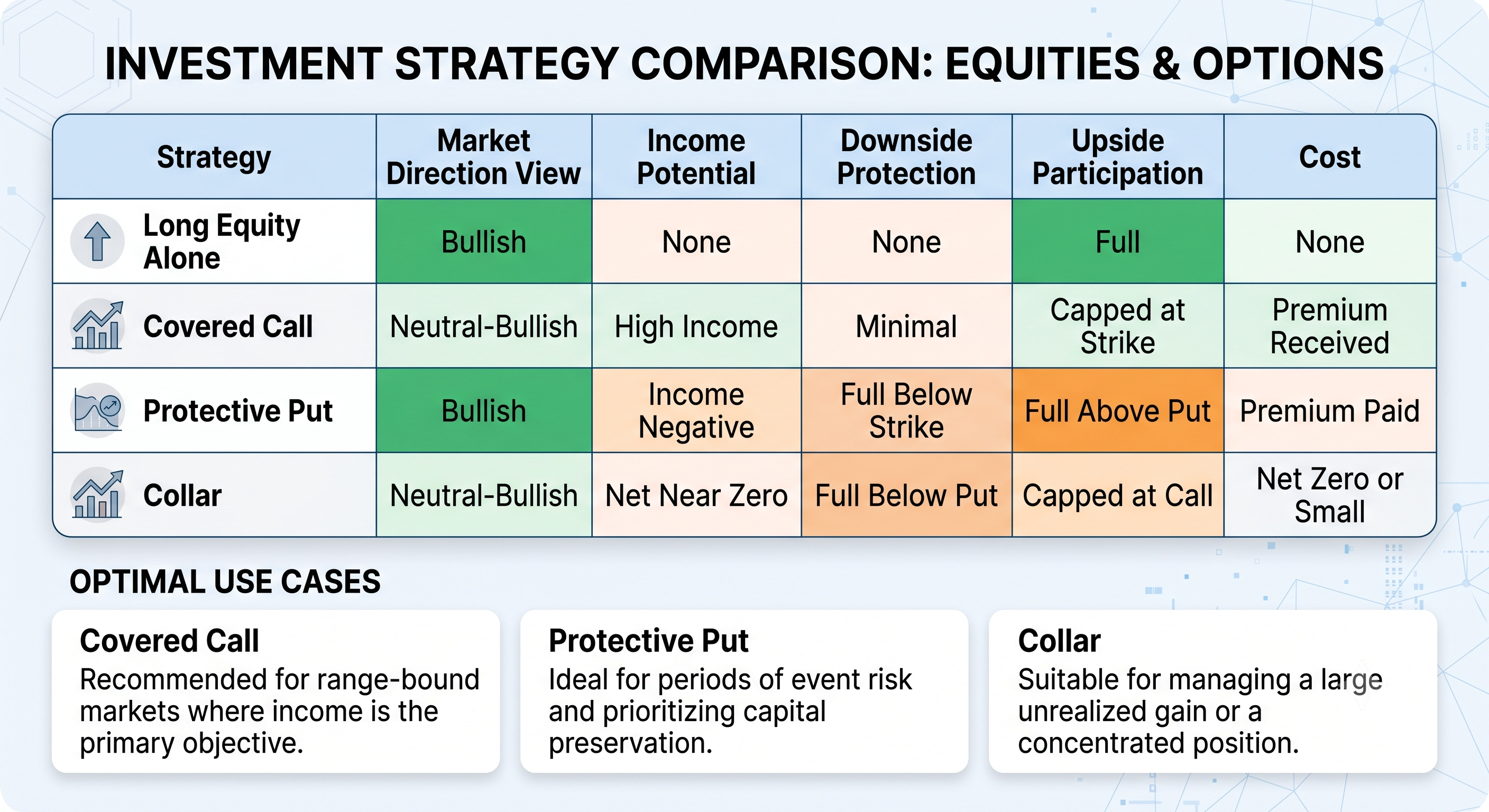
"The risk-reward matrix compares the covered call and protective put across five dimensions: market direction view, income objective, protection objective, upside capture, and psychological requirements. Each dimension produces a clear preference for one strategy over the other in specific circumstances. Together, the five dimensions create a complete framework for strategy selection that can be applied to any equity holding in any market environment. "
Dimension 1 - Market Direction View
Covered call: optimal for neutral to mildly bullish views. The investor expects the stock to appreciate modestly or stay flat in the near term -- but not to make a large advance. If the stock is expected to advance significantly, the covered call caps the gains from that advance. The covered call writer who is strongly bullish is paying for a position (capping upside) that conflicts with the directional view. Correct application: stocks at support in a range-bound environment, after a significant run when consolidation is expected.
Protective put: optimal for bullish views with specific downside concern. The investor is bullish on the stock (intends to hold it) but is concerned about a specific downside scenario (an event, a technical level, a valuation concern). The protective put maintains the full bullish upside while eliminating the specific downside scenario. Correct application: holding a position through a high-risk event (Budget, earnings) while maintaining the long-term bullish thesis intact.
If You Are Bearish, Neither Strategy Is Appropriate
Both the covered call and the protective put assume the investor is long the underlying equity and intends to remain long. If the investor is bearish (believes the stock or the market will decline significantly), the appropriate action is to sell the equity position (if the holding costs and tax implications are acceptable) or to use a standalone long put (Topic 11.8) for directional bearish exposure. The covered call is not a bearish strategy -- its net position is long equity with capped upside. The protective put is not a bearish strategy -- it is insurance for a bullish long equity position. Both strategies require long equity conviction as their foundation.
Dimension 2 - Income Objective
Covered call: specifically designed for income generation. Generates premium income regardless of the stock's movement (as long as the stock stays below the strike). The income is immediate, certain, and defined when the call is written. Best income-generation strategy for equity investors who want current income from their holdings. The covered call can generate 1 to 4 percent monthly income on the equity holding's value -- significantly higher than dividend yields from most Indian equity holdings.
Protective put: income-negative. The protective put costs premium rather than generating it. It is purely a risk management expense -- spending current income to protect against future losses. The protective put reduces net investment returns by the premium paid. It has no income generation purpose. Choosing a protective put for income generation is a category error.
Dimension 3 - Protection Objective
Covered call: minimal protection. The premium received (typically 1 to 3 percent of the stock value per month) provides only marginal downside cushion. A stock that falls 20 percent is not meaningfully protected by a 2 percent monthly call premium. The covered call should never be selected primarily for its downside protection -- the protection it provides is incidental and minimal. Correct statement: the covered call generates income with a small incidental downside cushion.
Protective put: purpose-built for protection. Provides defined, specific protection against declines beyond the strike price. The protection is proportional to the position size (hedge sizing) and is designed for the specific downside scenario the investor is managing. Best protection strategy for equity investors who want to maintain long equity exposure with a defined maximum loss.
Dimension 4 - Upside Capture
Covered call: upside is capped at the call strike. Every advance above the call strike is forgone -- the call writer has sold the right to all upside above the strike. In a strongly trending market, this cap is the most significant cost of the covered call strategy. In a flat or gently rising market, the cap is rarely reached and the income is collected without upside restriction.
Protective put: full upside capture. The protective put does not cap the equity position's upside at all. If the stock or market advances significantly, the put expires worthless and the full equity gain is captured minus only the put premium cost. This is the fundamental advantage of the protective put over the covered call: maintaining unlimited upside potential while limiting the downside.
Dimension 5 - Psychological Requirements
Covered call: requires the psychological ability to accept assignment. The covered call writer must genuinely be at peace with the possibility that the shares will be called away at the strike price -- even if the stock subsequently rises further above that level. Investors who feel 'tricked' or 'cheated' when their shares are assigned (because the stock kept rising) will have difficulty managing covered calls consistently. The psychological prerequisite: genuine acceptance of the strike price as a satisfactory exit level when writing the call.
Protective put: requires the psychological ability to accept the recurring premium cost. The protective put buyer must accept that the insurance premium may be paid for months without the protection being needed -- similar to paying annual home insurance premiums without ever filing a claim. Investors who feel the put premium is 'wasted money' when the market rises will abandon the protective put strategy precisely when it is most needed (before the next decline). The psychological prerequisite: genuine acceptance of the insurance cost as a legitimate investment expense independent of whether the protection is ever triggered.
The covered call and the protective put are not competing strategies -- they serve fundamentally different investor needs. The covered call serves the income-seeking equity investor in a neutral market. The protective put serves the preservation-seeking equity investor in an uncertain market. Understanding which need is currently primary for a specific holding determines which strategy is appropriate for that holding at that time. The same investor may use the covered call on one holding and the protective put on another, based on the holding's specific risk profile and the investor's current objective for that position.
Build a Per-Holding Strategy Assessment Once Per Quarter
For each significant equity holding, conduct a per-holding strategy assessment once per quarter: (1) What is the current directional view on this holding? Neutral to mildly bullish (covered call candidate) or strongly bullish with specific event risk (protective put candidate) or both (collar candidate)? (2) What is the income objective for this holding? Income needed now (covered call) or income not needed, protection more important (protective put)? (3) What is the upcoming risk calendar for this holding (earnings, sector events)? If significant events are upcoming: protective put. If no significant events and stock is range-bound: covered call. This quarterly assessment converts strategy selection from an ongoing uncertainty into a systematic per-holding process.
Frequently Asked Questions
An investor holds HDFC Bank shares with a large unrealised 40% gain from purchase price. The Union Budget is in 3 weeks. After the Budget, the investor needs the capital for a property purchase in 6 months. Which strategy is most appropriate and why?